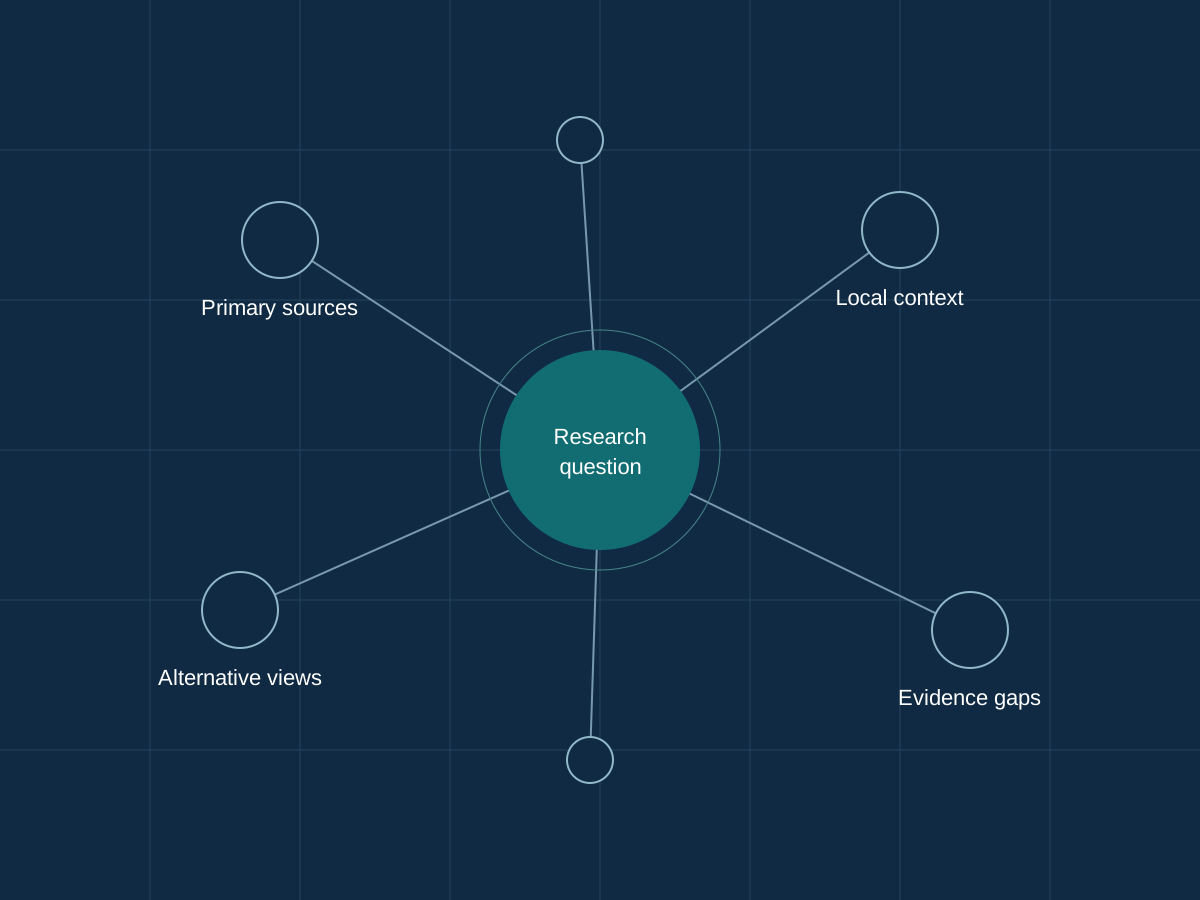
A broad area of interest is a good beginning, but it is difficult to estimate work or data needs from a topic alone. A concise brief makes the desired answer, boundaries and important constraints visible before effort is spent on the wrong scope.
Write down the decision and audience
Describe who the research is for and what they hope to understand or decide. A team comparing news-feed options, for example, might want a defensible estimate of the minimum data scope for a methodology pilot. That is different from building a production service or making an investment decision.
State what the work is not intended to establish. A small study may describe sample coverage and workflow requirements; it should not imply a complete market census, the performance of a strategy or access to a product that has not been obtained.
Draw the boundaries
Name the markets, sectors, organizations, languages and dates in scope. Decide whether the unit of analysis is a company, announcement, economic release, article or calendar event. Add explicit exclusions where they prevent the scope from being misunderstood.
Set a practical time window and say whether the question is historical, ongoing or comparative. If a wider scope depends on access to a paid or restricted source, identify it as an assumption that must be confirmed, not as a guaranteed input.
List the evidence and access needs
Separate sources already available from sources that require a request, subscription or permission. Record the fields and examples you need, how often information changes, whether historical versions matter and who will see the material. For licensed information, ask the provider to confirm permitted research, storage, quotation and publication uses in writing.
A short source matrix can reveal that some questions are answerable from public filings or a bounded sample, while others genuinely depend on a specialized feed. This can help narrow an expensive requirement before requesting a formal quote.
Define the output and a useful finish
Name the format and its audience: a short report, comparison sheet, source map, research note or presentation. Describe what it should include, such as documented definitions, example records, limitations, open questions or a recommendation for the next research step.
A good acceptance criterion is observable. For example: “The note lists the required data categories, unresolved coverage questions and quote assumptions for a defined research sample.” That is clearer than “understand the market data landscape.”
Record dependencies, not just dates
List what the researcher needs from others: a project sponsor’s scope approval, a data vendor’s product response, access permissions or a sample file. A delivery date depends on those inputs. Mark what can begin without them and what cannot.
Close the brief with a small set of unanswered questions, a check-in point and the conditions that would trigger a scope change. A vendor quote is easier to interpret when it is attached to the exact question, coverage, users and intended use it assumes.
A strong brief is a shared description of the question, the work needed to answer it and the conditions a useful answer must meet.
An original methodological perspective from the Geteridian research concept. This article is educational and does not provide investment recommendations or report live market data.